Case study: Is new agronomy needed for paludi-crops?


This is the third in a series of case sudies written by freelance journalist and technical writer Teresa Rush.


Overview
Paludiculture is a farming system on wet or rewetted peatlands which maintains high water tables to protect carbon stocks and ecosystem services. Conventional agronomy - designed for dry soils and machinery access - cannot be directly applied to these wet landscapes.
Two complementary Paludiculture Exploration Fund (PEF) projects explored this challenge: Drone RePeat, which tested autonomous aerial systems for crop establishment and management, and Unlocking Typha, which optimised Typha seedhead production for fibre and other high-value products. Together, they illustrate that new agronomy must be systems-oriented, integrating biology, technology, and operational management.
This case study examines whether new, systems-level agronomy is needed for wet peat farming and, if so, what that new agronomy looks like in practice.
The challenge
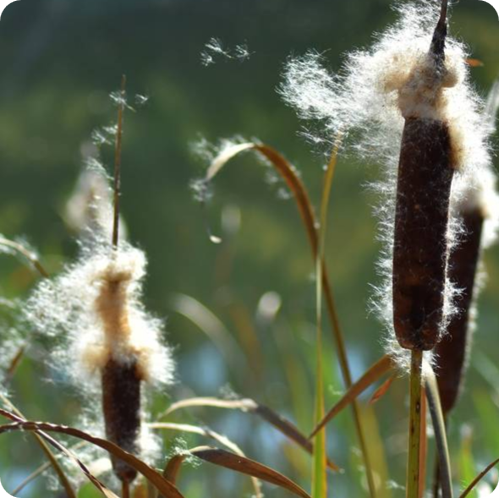
High water tables restrict machinery access and precision, making sowing and early crop establishment difficult. Key questions include:
How can seeds be effectively sown on wet peat for optimal crop establishment?
How can crops be managed to maximise productive seedheads?
As Dr Marcus Bellett-Travers (Drone RePeat) observes:
“Typha seed is like dust – the slightest wind, and it is gone.”
This highlighted the need to rethink both delivery systems and crop management practices.
Key insights:

Seed delivery innovation: Hydrogel suspensions and clay pellets were tailored to water depth and seed biology.
“The light-bulb moment was using the drone’s ability to spray a thick liquid via its peristaltic pump, suspending the seed in a gel.” - Dr Marcus Bellett-Travers
Operational scale: Coverage of up to 5 hectares per hour; up to 40kg of seed per flight.
Timing matters: Optimal sowing window for Typha identified as May-June, feeding into AI-driven decision support.
“It became evident there was an optimum time to sow Typha seed using a drone.” - Dr Marcus Bellett-Travers
Regulatory breakthrough: Secured the UK’s first CAA BVLOS Operational Authorisation in an Atypical Air Environment, enabling repeatable and insurable operations.
Systems-level learning: Success required integrating hydrology, seed biology, drone engineering, and regulatory compliance, not technology alone.
Innovations in crop productivity: Unlocking Typha

The Unlocking Typha project, conducted by ADAS, focused on improving yield and quality of Typha seedheads through controlled trials on planting density, rhizome maturity, and pest management.
Key findings:
Establishment and maturation: Year 1 builds rhizome reserves; flowering occurs in Year 2.
“Typha doesn’t just respond to light and warmth; it also needs healthy, mature rhizomes with enough stored energy to trigger flowering.” - Islam Abdel-Aziz, RSK ADAS
Density effects: Lower-density planting (30 rhizomes/m²) produced larger seedheads than higher density (100 rhizomes/m²), even when counts were similar.
Pest management: Early intervention is essential to prevent malformations and loss of quality.
“Damage to the plants in the trials ranged from fibre protrusion and longitudinal splitting of seed heads to the abortion of heads.” - Islam Abdel-Aziz, RSK ADAS
Hydrology matters: Water depth and irrigation influence establishment success and yield quality.
Integrated insights: Why new agronomy is needed

Both projects highlight that paludiculture requires systems-level agronomy:
Technology as an enabler: Drones and AI extend capability but must align with seed biology and hydrology.
Hydrology-sensitive management: Water table depth is central to establishment and yield.
Data-driven decision-making: AI and monitoring enable precision at scale.
Conclusion

Paludiculture requires new, systems-level agronomy that integrates seed biology, wetland hydrology, delivery mechanisms, aviation safety, regulation, and data intelligence. Drones and robotics are not simply tools; they are enablers of entirely new farming systems, making it possible to farm with water, rather than against it.
Project Links
A pdf copy of the case study can be downloaded here


Comments