Case study: Wetter farming for food production - practice and potential


This is the fourth in a series of case studies written by freelance journalist and technical writer Teresa Rush.


Overview

Paludiculture - farming on rewetted peatlands - is an agricultural system that enables the productive use of peat soils under wet conditions. Instead of draining peatlands for conventional agriculture, paludiculture supports crops that are naturally adapted to wetter environments, allowing them to grow competitively while maintaining high water tables.
This approach offers a promising pathway for the continued economic use of lowland peatlands while significantly reducing the greenhouse gas emissions associated with drainage-based farming. By restoring wetter conditions, paludiculture helps preserve peat soils, which are important carbon stores, while creating opportunities for new agricultural systems.
Research in the UK has identified 88 native wetland species with potential value across multiple sectors, including food, energy, fodder, medicinal products, and raw materials. As concerns around national food security increase, interest in developing paludicultural food crops is growing, with attention turning to how these could contribute to resilient and sustainable food production systems.
This case study explores how projects funded through the Paludiculture Exploration Fund (PEF) and other funding sources have investigated the feasibility of growing food crops within wetter farming systems. These initiatives aim to test crop suitability, management practices and impacts on yield and quality while ensuring that peat soils are protected and greenhouse gas emissions are reduced. Together, they provide important insights into how paludiculture could support both environmental restoration and agricultural productivity.
Project: Fenland SOIL paludiculture trial
The PEF-funded project Fenland SOIL conducted a three-hectare paludiculture trial in conjunction with G’s Norfolk Farms, a commercial vegetable farm specialising in intensive salad cropping.
The trial aimed to test whether commercial-scale crop production could continue under wetter soil conditions that better protect peat soils.
The site was chosen due to its strong hydrological infrastructure:
Located near both a river and a reservoir, providing a reliable water supply
Two Internal Drainage Board (IDB) drains feed water from the River Wissey
Water flows through a controlled inlet system and along a drain to a dam
Land drains spaced every 10 metres allow precise water management
Before the trial began, the field was laser-levelled to ensure consistent water distribution.
During the growing season, the water table was maintained between 10 and 30 cm below the soil surface, considerably higher than under conventional farming systems.
Crops tested

The crops chosen for the trial - celery, Chinese leaf, lettuce, and miscanthus - were already grown on the farm and are relatively shallow-rooted and tolerant of higher water tables. Initially, crops were harvested by hand due to the wet conditions. In later trials, the water level was temporarily lowered to allow machinery such as a lettuce harvesting rig to enter the field.
Monitoring and data collection
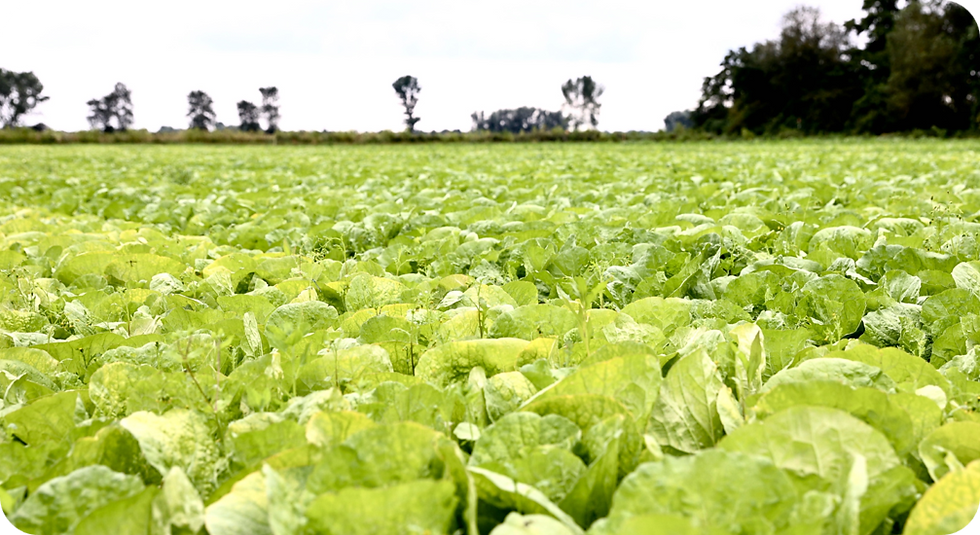
Greenhouse gas emissions were monitored throughout the experiment by the UK Centre for Ecology and Hydrology (UKCEH). Measurements included: carbon dioxide (CO₂), methane (CH₄), nitrous oxide (N₂O). Both trial plots and conventional control fields were monitored to allow direct comparison.
Environmental outcomes

The results demonstrate that wetter farming can significantly reduce greenhouse gas emissions from peat soils. CO₂ emissions fell by 38% in celery and 47% in Chinese leaf under paludiculture conditions. Nitrous oxide emissions - a potent greenhouse gas - dropped dramatically in celery, decreasing by 90%, while remaining unchanged in Chinese leaf.
However, methane emissions increased. CH₄ rose by 11.8% in celery and 84% in Chinese leaf, with the site becoming a net methane emitter after early October. This highlights the complexity of greenhouse gas dynamics in rewetted peat systems, where reduced carbon oxidation may be partly offset by increased methane production.
Overall, the trials demonstrated substantial reductions in total greenhouse gas emissions compared with conventional cropping, confirming the environmental potential of wetter farming approaches.
Economic and production challenges

Despite environmental benefits, the trials revealed significant challenges for farm productivity and profitability. Crop quality declined under wetter conditions. Chinese leaf achieved a packing quality of 50%, compared with 65% in the control field, while celery dropped more dramatically to 34% compared with 85% under conventional drainage.
To maintain current production levels under the wetter system, land requirements would increase significantly - by around 30% for Chinese leaf and as much as 250% for celery.
Water management also proved challenging. Maintaining a consistent 10-30cm water table across the field was difficult due to variations in field topography, rainfall patterns, and water abstraction limits. Further trials aimed to test slightly deeper water tables of 30-50cm to improve operational practicality while still protecting peat soils.
“Our paludiculture trial demonstrated that intensive salad crops can be grown with a higher water table, though water management and operation issues reduced yields, highlighting the trade-offs between environmental benefits and economic viability.” Christian Kielinger, Fenland SOIL
Emerging opportunities

Other innovative crops are also being trialled.
At Mount Pleasant Farm near Ely in Cambridgeshire, farmers Craig and Sarah-Jayne Taylor are working with UKCEH researchers to test nine varieties of cold-hardy rice on rewetted peat soils.
The project explores whether rice - traditionally grown in waterlogged systems - could provide a future cropping option for wetter peat landscapes.
These trials are part of the AgZero+ project, funded jointly by the Natural Environment Research Council (NERC) and the Biotechnology and Biological Sciences Research Council (BBSRC).
Detailed measurements of the rewetted peats will include greenhouse gas emissions, carbon stocks, water use, crop yield and the impacts on nature.
Sarah-Jayne Taylor, farmer:
“Our Fenland soils are some of the most productive in the country but are very susceptible to the changing climate and we need to adapt the crops we grow and how we grow them. The trials are critical to understanding the practicalities of large-scale peat rewetting, including impacts on yields and farm income, as well as wider benefits for wildlife and flood prevention.”
Looking ahead

These projects illustrate the emerging transition toward wetter farming systems in peat landscapes. Current trials show that raising water tables can significantly reduce greenhouse gas emissions and slow peat degradation. However, technical, economic, and market challenges remain before widespread adoption becomes feasible.
Project Link
A pdf copy of the case study can be downloaded here


Comments